Friday, November 27, 2015

Resources for 3rd 6 Weeks Project

Powtoon.com – free animations software. Used to create presentations.      Lightning Thief 

Bitstrips Create comic strips 

Padlet.com – (wallwisher) insert pictures, videos texts or links, used for notetaking, and projects. With many students accessing the program and sharing information and producing a product with it.

Blabberize.com – take any picture and make it talk, to spice up presentationsJ quick and easy! You can add image to presentation or powerpoint.

Google earth – View an image of StonStory Jumperehenge, Giza Pyramid, Chichen Itza, screenshot and use in presentations or create tours of the ring of fire, used for presentations.

Dipity.com – timeline generator website, create a timeline for the creation of Stonehenge, Giza Pyramid, or Chichen Itza and add images.

Prezi - create online PowerPoint

Story Jumper - online book maker!

Wix.com – website creator or create games, to show your knowledge of things we have learned this semester.

Screencastomatic  -  create videos that work with presentations.

Project Guidelines - Due December 14, 2015
Do you want to build a monument that will last for 1,000's of years? What would it look like? Where would you build it? What materials would you use? What would you want to future to know?

Look at monuments that have lasted like Stonehenge, Giza Pyramids, Chichen Itza, Easter Island, what can you learn to help you with your monument?



Sunday, November 15, 2015

Motion and Speed

Links
Practice 1st Semester Lesson Objectives


Motion & Speed

Things to know....
Speed:  Distance divided by time. SI unit for speed is meters per second (mps)
Velocity: Speed with a direction. Example: 35mph is speed. 35 mph north is velocity.Acceleration:  A change in direction, speeding up, or slowing down.Motion: A change in position. When an object moves from one spot to another.Reference Point: Something that appears to be stationary, that is used to determine motion. 

  • The motion of an object can be described by its position, direction of motion and speed.
  • An unbalanced force acting on an object changes its speed and/or direction of motion.
  • Objects moving in circles must experience force acting toward the center.

Source of image: 
Motion: a change in position, measured by distance and time
Source of images:

  • An object is said to be in motion when its position changes in relation to a reference point
  • An object’s motion can be described and represented graphically according to its position, direction of motion, and speed
  • Motion of objects can be represented on a distance vs. time line graph, with distance traveled as the vertical (“y”) axis and time as the horizontal (“x”) axis.
 
  • The steepness and slant of the motion line vary depending on the speed and direction of the moving objects.
  • A straight horizontal line indicates an object at rest

Reference point: the point from which movement is determined.


A reference point can be any object or location.  It can be moving or stationary (unmoving).  The motion of another object can be compared to the reference point to determine whether the object is moving relative (moving toward, away from, or neither) to the reference point.

In the image, if the tree is the reference point, the car is moving away from from the reference point as it goes from position 1 to position 2.

Source of images:
  • An object to compare a moving object to
  • To measure movement, some point must be considered as nonmoving
  • Earth is the most common frame of reference
    

Speed: the distance traveled by a moving object per unit of time.
  • To calculate speed, use the equation 
 Speed = distance / time
  • Speed only gives distance and time.
  • Speed describes the change in an object’s position over a period of time, and is measured in units such as meters per second or miles per hour

Average speed: the speed of moving objects is not always constant:

Average speed = total distance / total time
  • Average speed takes into account the different speeds at which an object moves over a period of time
  • Average speed is calculated by dividing the total distance traveled by the change in time, ignoring any changes in motion or direction during its travel

Velocity: speed in a given direction.
  • Velocity gives distance, time, and the direction of travel

Graphing Speed

Relative Motion: See how motion is observed by the person observing it.

Distance Time Graph Activity: Interactive web page that lets you create your own distance-time graph by flying a space ship

Distance Time Graph Partner Activity: For 2 students - interactive web page that lets one person create the graph and the second person attempts to recreate the same graph by moving a second spaceship across the screen

Need for Speed: Speed, Direction, and Velocity with a car

Despicable Me - Vector Clip

Tuesday, November 10, 2015

Forces

What are forces?  BrainPop Quiz

 video  

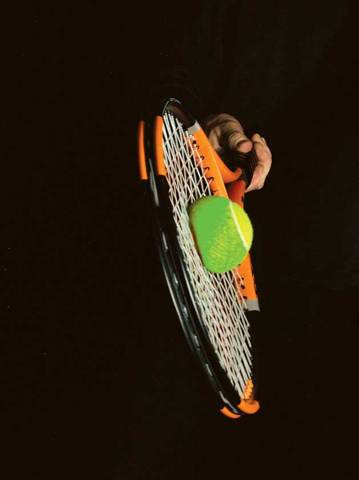
Why is one side of the ball flat?
Visuals Unlimited/Corbis
A ball, such as this tennis ball, is usually round. Its shape lets it roll farther and travelfarther in the air. What could cause part of a ball to become flat like this one? Does thesame thing happen when a baseball hits a bat? Or when a golf club hits a golf ball?
What do typing on a computer, lifting a bike, and putting on a sweater have in common?They all involve an interaction between you and another object. You push on the keys. Youpush or pull on the bike. You pull on the sweater. A push or pull on an object is a force.
Forces affect motion of everyday life. Seedlings emerging through soil or growing towardsthe sun are examples of how objects around us are affected by forces.  You are sitting on Earth due to a very powerful force - gravity!
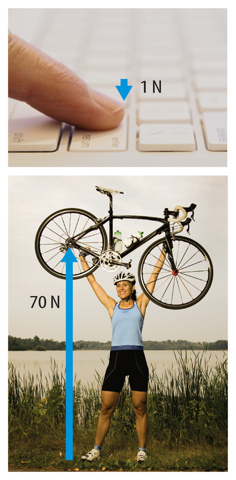
A force has both size and direction. In Figure 1, the length of the arrow represents the sizeof the force. The direction in which the arrow points represents the direction of the force.The unit of force is the newton (N). It takes about 4 N of force to lift a can of soda.
There are two ways a force can affect an object. A force can change an object’s speed. It also can change the direction in which the object is moving. In other words, a force can cause acceleration. 

Recall 
that acceleration is a change in an object’s velocity, its speed and/or its direction in a given time. When you apply a force to a tennis ball, such as the one shown in the picture above, the force first stops the motion of the ball. The force then causes the ball to accelerate in the opposite direction, changing both its speed and direction.
1. Reading Check In what ways can forces affect objects?

(t) Anthony-Masterson/Getty Images, (b)Per Breiehagen/Getty Images
Figure 1 The arrows show forces with very different sizes acting in opposite directions.

Types of Forces
Some forces are easy to recognize. You can see a hammer applies a force as it hits a nail. Other forces seem to act on objects without touching them. 

For example what force causes your ice cream to fall toward the ground if it slips out of the cone?

Contact 
Forces

The 
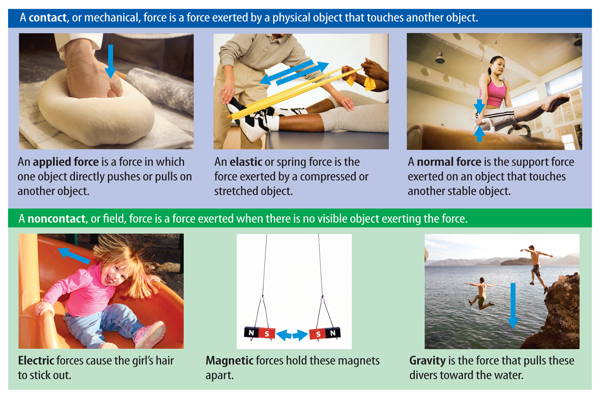
top left image of Figure 2 shows a baker pushing his hand into dough, causing the top of the dough to accelerate downward. You can see the baker’s hand and the dough come into contact with each other. 
A contact Force is a push or a pull applied by one object to another object that is touching it. Contact forces also are called mechanical forces. The top half of Figure 2 also shows other types of contact forces.A growing seedling is an example of an applied force.  As the plant pushes on the seed walls, the walls begin to crack and the seedling emerges from the seed pod. 

(tl) Visual Cuisines/Getty Images, (tc) Photodisc/Alamy, (tr) Floresco Productions/Corbis, (bl) Mark Spowart/Alamy, (bc) sciencephotos/Alamy, (br) Steve Casimiro/Getty Images
Figure 2 The pictures in the top row show examples of various types of contact forces. The ones in the bottom row show examples of several types of non-contact forces.

Noncontact Forces
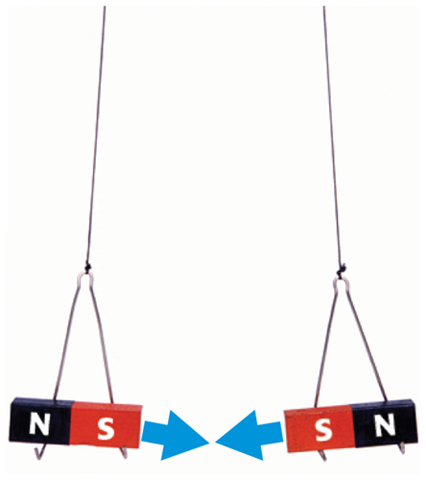
The bottom left image of Figure 2 shows a girl’s hair being pulled toward the slide even though it isn’t touching the slide. A force that pushes or pulls an object without touching it is a noncontact force. The force that pulls the girl’s hair is an electricforce. The bottom half of Figure 2 shows other noncontact forces, such as magnetismand gravity.

Noncontact forces affect all motion in everyday life.  For example, a plant growing in soil is affected by gravity.  The root system of a plant grows toward gravity. The response of a plant to gravity is called geotropism.

1
.
 Key Concept Check What is the difference between the way contact andnoncontact forces affect objects?
 MiniLab: How does friction affect an object’s motion?

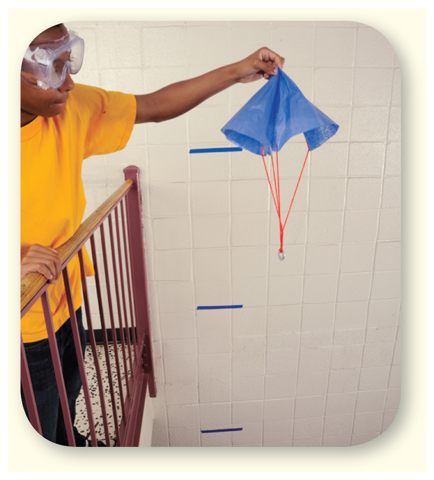
Air resistance is a force that opposes the motion of an object moving through air.

Hutchings Photography/Digital Light Source
1. Read and complete a lab safety form.
2. Make a model parachute from tissue paper, string, tape, and a metal washer.
3. Use a meterstick or metric tape measure to measure heights of 1, 2, 3, and 4 meters on a nearby wall. Mark them with tape.
4. Drop the parachute from the 4m mark. Your partner should start a stopwatch assoon as you drop the parachute and should stop the stopwatch when the washer passes the 3- mark. Repeat this step three more times stopping the stopwatch at the 2- mark, the 1- mark, and the ground. Record the times in your ScienceJournal.
5. Remove the washer from the parachute. Measure and record the time for the     washer to fall from the 4-m mark to the floor without the parachute.

Think About This
1. Graph the motion of the parachute on a distance-time graph.
   (
Hint: Place time onthe x-axis and distance on the y-axis.)
2. Calculate the average speed of the washer with and without the parachute     using the data from the 4 m height.   Use the equation average speed (m/s) = distance/time to calculate average speed.
3. Key Concept How did friction affect the speed of the parachute and the washer
Friction
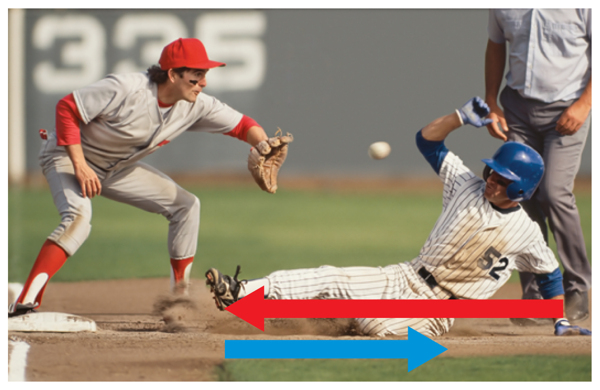
Why does the baseball player in Figure 3 slow down as he slides toward the base?Friction is a contact force that resists the sliding motion between two objects that aretouching. The force of friction acts in the opposite direction of the motion, as shown bythe blue arrow. Rougher surfaces produce greater friction than smooth surfaces.Other factors, such as the weight of an object, also affect the force of friction.

David Madison/Getty Images
Figure 3 The player must overcome friction or he won’t reach the base.
Gravity
Is there anywhere on Earth where you could drop a pencil and not have it fall? No!Gravity is a noncontact attractive force that exists between all objects that have mass.
Mass is the amount of matter in an object. Both your pencil and Earth have mass.They exert a gravitational pull on each other. In fact, they exert the same gravitational force on each other. Why doesn’t your pencil pull Earth toward it? It actually does! The pencil has very little mass, so the force of gravity causes it to rapidly accelerate downward toward Earth’s surface. Earth “falls” upward toward the pencil at the sametime, but because of its mass, Earth’s motion is too small to see.
Distance and Gravity
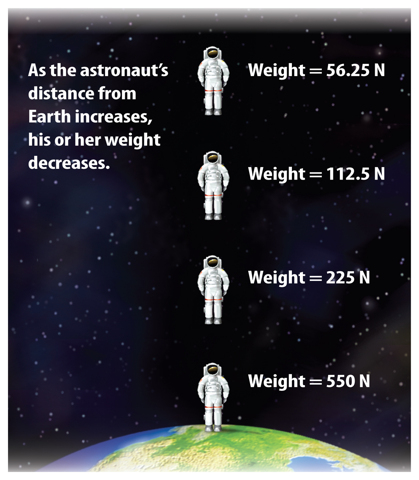
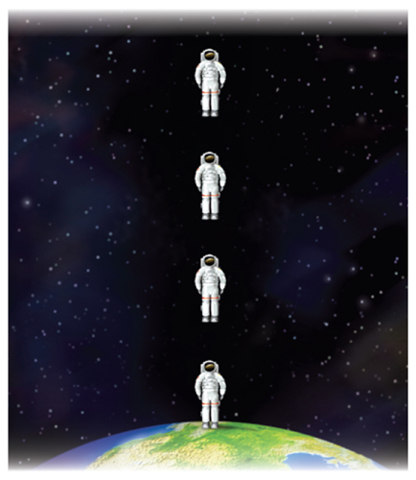
You may have heard that astronauts become weightless in space. This is not true.Astronauts do have some weight in space, but it is much less in space than theirweight on Earth. Weight is a measure of the force of gravity acting on an object. Astwo objects get farther apart, the gravitational force between the objects decreases.Figure 4 shows how the weight of an astronaut changes as he or she moves farther from Earth.
Figure 4 Gravitational force (weight) decreases as the distance between the centersof the objects increases.
You know that all objects exert a force of gravity on all other objects. If the astronaut drops a hammer on the Moon, will it fall toward Earth? No, the attraction between the Moon and the hammer is stronger than the attraction between Earth and the hammer because the hammer is very close to the Moon and very far from Earth. The hammer will fall down toward the Moon.
Mass and Gravity
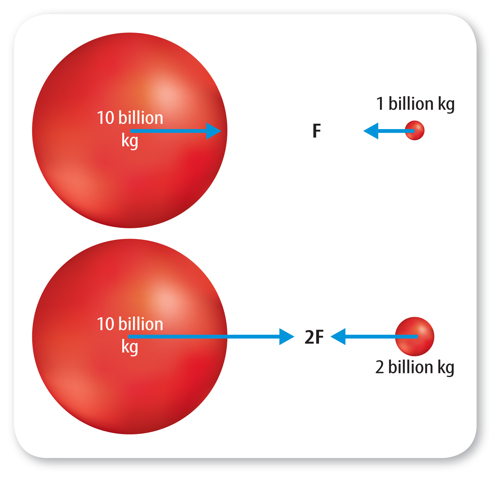
Another factor that affects the force of gravity between two objects is the mass of the objects. As the mass of one or both objects increases, the gravitational force betweenthem increases. For example, in Figure 5, F stands for the gravitational force. As the figure shows, doubling the mass of one of the objects doubles the force of attraction.
The effect of mass on the force of gravity is most noticeable when one object is very massive, such as a planet, and the other object has much less mass, such as a person. Even though the force of gravity acts equally on both objects, the less massive object accelerates more quickly due to its smaller mass. Because the plane accelerates so slowly, all you observe is the object with less mass “falling” toward the object with greater mass.
1. Key Concept Check What factors affect the way gravity acts on objects?
Figure 5 The force of attraction between the bottom two objects is twice as much asbetween the top two objects.
Visual Check Describe the acceleration of the bottom spheres due to thegravitational force between them.
WORD ORIGIN
gravity
from Latin gravitare, means to unite, join together
Combining Forces
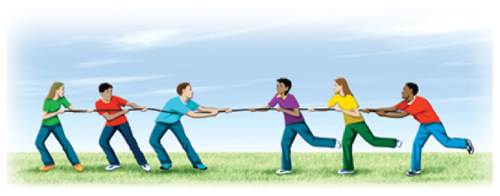
Have you ever played tug-of-war? If you alone pull against a team, you will probablybe pulled over the line. However, if you are on a team, your team might pull the ropehard enough to cause the other team to move in your direction. When several forces act on an object, the forces combine to act as a single force. The sum of the forces acting on an object is called the net force.
Forces in the Same Direction
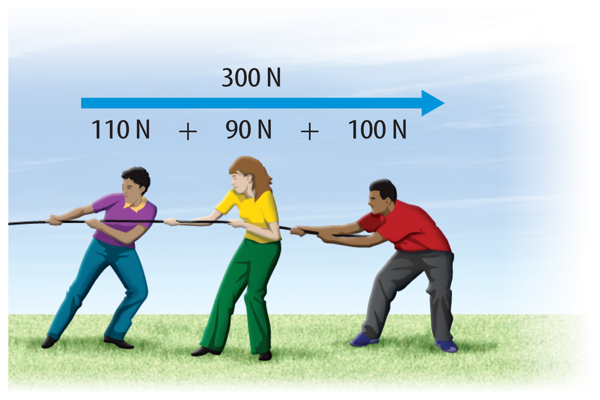
When different forces act on an object in the same direction, you can find the net force by adding the forces together. In Figure 6, each team member pulls in the samedirection. The net force on the rope is 110 N + 90 N + 100 N = 300 N.
Figure 6 Forces in the same direction act as a single force.
Visual Check What would the total force be if the person on the right stopped pulling?
Forces in Opposite Directions
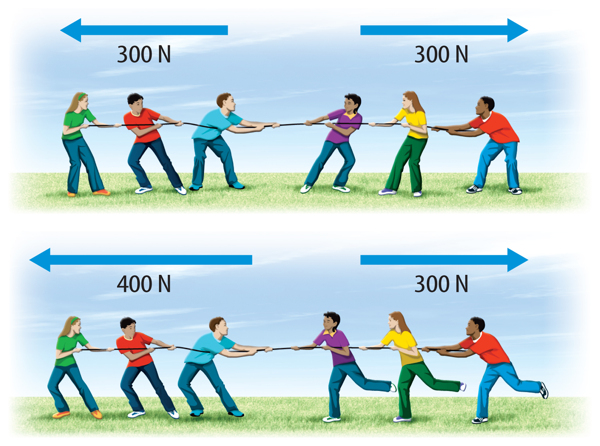
When forces act in opposite directions, you must include the direction of the forcewhen you add them. Like numbers on a number line, forces in the direction to the right are normally considered to be positive values. Forces to the left are negative values.In the first panel of Figure 7, the team on the right pulls with a force of 300 N. The team on the left pulls with a force of −300 N. The net force is 300 N + (−300 N) = 0.
Figure 7 No change in motion takes place when forces on an object are balanced.Unbalanced forces cause the team on the right to accelerate to the left.
Balanced and Unbalanced Forces
The net force on the rope in the top of Figure 7 is 0. When the net force on an objectis 0 N, the forces acting on it are balanced forces. If the forces acting on an objectare balanced, the object’s motion does not change. When the net force acting on an object is not 0, the forces acting on the object are unbalanced forces.

The forces acting on the rope in the bottom of Figure 7 are unbalanced. 
Unbalanced forces cause objects to change their motion, or accelerate.
1. Key Concept Check How do balanced and unbalanced forces differ?
Lesson Review
Visual Summary
Forces are pushes and pulls exerted by objects on each other. Contact forces occur when objects are touching. Noncontact forces act from a distance.

sciencephotos/Alamy
Gravity is a force of attraction between two objects. The amount of gravitational force depends on the mass of the objects and the distance between them.
Balanced forces do not affect motion. Unbalanced forces change motion.
Lesson Assessment
Use Vocabulary
1. Describe friction in your own words.
2. Two examples of __________ are gravity and magnetism.

Understand Key Concepts
3. As the distance between two objects increases, the gravitational force between    the objects
      A. increases.
      B. decreases.
      C. creates friction.
      D. stays the same.
4. Describe the forces acting on a cyclist who is slowing down as he or she     climbs a hill.
5. Identify any balanced and unbalanced forces acting on a book resting on a table.

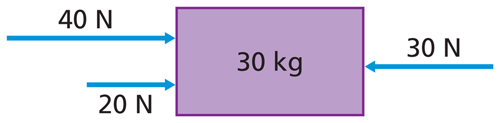
Use the figure below to answer question 6.
6. What is the net force on the object?
      A. 30 N to the right
      B. 30 N to the left
      C. 60 N to the right
      D. 90 N to the left
7. Which is a contact force?
      A. A girl pulls the plug of an electric hair dryer from the socket.
      B. A leaf falls to the ground because of Earth’s gravitational force.
      C. A magnet pulls on a nail 2 cm away.
      D. A small bit of paper is pulled toward an electrically charged comb.
Interpret Graphics
8. Copy and complete the graphic organizer to explain how distance and mass    affect the force of gravity.

Illustration of a graphic organizer labeled gravitational force
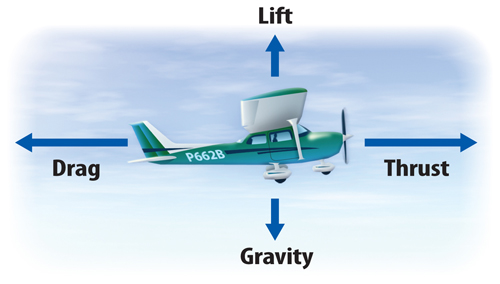
9. Analyze the four forces acting on the airplane flying at an altitude of 3,000 m, as    shown below. 
       How 
do the forces affect the plane’s motion?
Illustration of an airplane in the sky. An arrow above the airplane is pointing up and labeled Lift; an arrow in front of the airplane (at the nose) is poiting to the right and is labeled Thrust; an arrown below the airplane is pointing down and labeled Gravity; and an arrow behind the airplane (at the tail) is pointint to the left and labeled Drag.
Critical Thinking
10. Construct a diagram that shows three forces acting on an object in the samedirection and two forces acting in the opposite direction. Give the forces values that would cause no change in motion.
11. Contrast the force of gravity between these pairs of objects:      
      a 
1-kg mass and a 2-kg mass that are 1 m apart;       a 1-kg mass and a 2- kg mass that are 2 m apart;       two 2-kg masses that are 1 m apart.
12. Give an example of a contact force and a noncontact force that affect plants.
13. While carrying a heavy box up the stairs, you set the box on a step and rest.      Then you pick up the box and carry it to the top of the stairs. Describe these       actions in terms of balanced and unbalanced forces acting on the box.